The four phrases are: “I'm sorry.” “Please forgive me.” “Thank you.” “I love you.” They belong to the modern form of Ho'oponopono, not to the traditional Hawaiian family process. Hooponopono Mirror shows them one at a time while the front camera works as a mirror.
In what order are they said?
The order differs between sources. The 2007 book Zero Limits gives the phrases as “I love you. I'm sorry. Please forgive me. Thank you.” Many other sources start with “I'm sorry”. There is no single fixed order.
In Hooponopono Mirror the phrases appear in this order: I'm sorry, forgive me, thank you, I love you. Each phrase is shown alone on the screen.
Where do the phrases come from?
The traditional Hawaiian process described by Mary Kawena Pukui is a family conference with prayer, discussion, confession, repentance and forgiveness. It is not described as the repetition of four phrases.
The four-phrase form belongs to the modern versions that followed Morrnah Simeona's work in the 1970s. Ihaleakalā Hew Len and Joe Vitale described the phrases in the 2007 book Zero Limits. Read more on the page “What is Ho'oponopono?”.
How does the app word them?
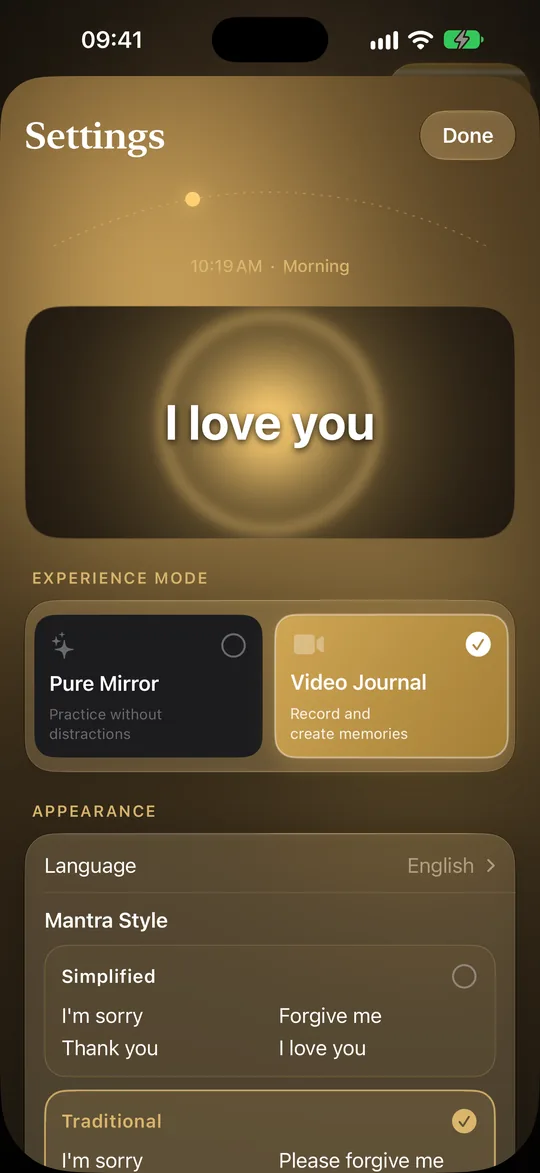
The Settings screen offers two mantra styles. The names are the app's own labels.
| Style in the app | Wording |
|---|---|
| Simplified | I'm sorry · Forgive me · Thank you · I love you |
| Traditional | I'm sorry · Please forgive me · Thank you · I love you |
“Traditional” is only the name of the longer wording in the app. It does not claim that this wording is the old Hawaiian form. The app follows your phone language, and the wording of the phrases differs from language to language.
How do the phrases appear in the app?
The four phrases appear one by one. In Settings you choose how many seconds each phrase stays on screen and how long each pause lasts. The default is 3 seconds for each phrase and 3 seconds for each pause.
In the app
Settings shows the phrase preview, the Experience Mode (Pure Mirror or Video Journal) and the Mantra Style.
Try it in the app
Download on the App Store Android — coming soon
Early access on request: write to contact@hooponoponomirror.com.
Read next
Sources
- Hoʻoponopono, Wikipedia (English), read 16 November 2026
- Joe Vitale and Ihaleakalā Hew Len, Zero Limits, John Wiley & Sons, 2007 (as cited in the Wikipedia article above)
- Mary Kawena Pukui, E. W. Haertig and Catherine A. Lee, Nānā i ke Kumu (Look to the Source), volume 1, Hui Hānai, 1972 (as cited in the Wikipedia article above)
- Hooponopono Mirror, App Store listing text (approved 13 November 2026)
Ho'oponopono Mirror is a personal reflection tool. It is not a medical device and does not replace a professional.